Solar farms, wind turbines, batteries, and power lines all need regular work after installation. Robots could take on some of the inspection, cleaning, transport, and repair tasks that add cost when people must travel to large or difficult sites.
Quick read
- Robots can inspect equipment without sending a worker across a large site.
- Repeated tasks, such as panel cleaning, suit machines better than one-off repairs.
- Lower labor and downtime costs matter only if the robot is reliable enough to justify its price.
Where the savings could come from
A clean-energy project earns money when it keeps producing power. A blocked solar panel, a damaged cable, or a wind turbine waiting for inspection can reduce that output. Finding the fault early could help shorten the gap between failure and repair.
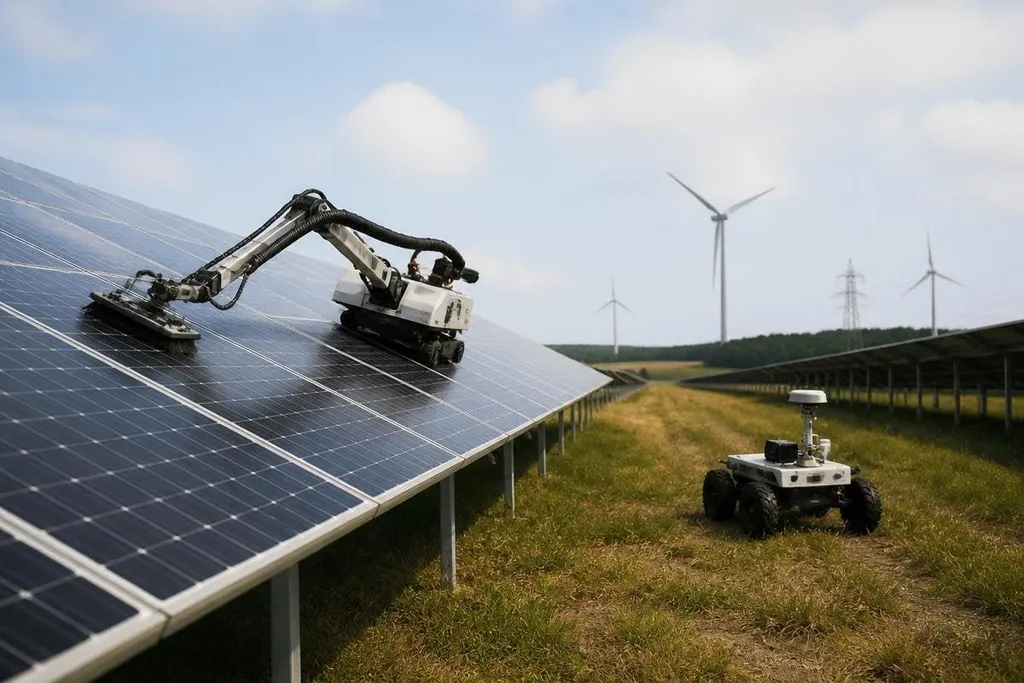
The savings would come from several parts of the work. A machine could move across a solar field, inspect panel surfaces, and record images for a technician. Another system could carry tools or parts across a site, reducing the walking and driving time tied to routine jobs.
Those gains depend on the task. Repeated work in a known area is easier to plan than a repair that needs judgment, force, or a change of tool. A robot may handle inspection well while a trained technician still needs to decide what the fault means and how to fix it.
Solar panels and battery sites
Solar panels cover large areas, so inspection can involve many rows and long travel between equipment. A mobile robot could follow planned routes, use cameras to find visible damage, and send the images to a person for review.
Cleaning is another possible use. Dust, leaves, and other material can reduce the light reaching a panel, but a cleaning robot would need to move without scratching the panels or damaging cables. Water use also matters, especially at sites in dry regions.
Battery sites raise a different set of demands. Robots could carry heavy modules, inspect rooms, or check for heat and other warning signs. A person would still need to set the safety rules, approve access, and respond when the robot reports a problem.
Wind turbines add height, distance, and changing weather to the maintenance problem. Robot24.com's renewable energy robotics reporting gives you the named machine, site, task, and test date needed to judge whether a robot can inspect equipment outside the lab.
Wind power and hard-to-reach equipment
Wind turbines place equipment high above the ground and far from service bases. Checking blades or gathering images with a robot could reduce the number of climbs or rope-access visits needed for routine inspection.
The machine would need to deal with wind, rain, uneven surfaces, and poor communications. It would also need a safe way to stop when conditions change. Those limits make inspection a more realistic early task than fully automated repair.
The same point applies to power lines and other energy equipment. On a planned route, the robot may spot surface damage or carry a sensor, while a human team handles the repair. The value comes from giving technicians better information before they arrive.
The cost that can erase the saving
Buying a robot is only one part of the bill. A project may also need charging equipment, software, spare parts, training, remote supervision, and a safe place to store the machine.
The robot must work often enough to spread those costs across many jobs. A machine used once each month may cost more than a human team, even if it completes that visit faster.
A machine that works every day has a stronger case, but only if maintenance and weather delays stay within the project plan.
Data quality matters too. A camera can collect images, but someone still needs to sort them, check false alarms, and decide which faults deserve a visit. If that review work grows with every inspection, the robot has moved the cost rather than reduced it.
A practical buying checklist
Use these checks before treating a robot as a cost-saving tool:
- Name the task: Write down the exact job, its frequency, and the time a person spends on it now.
- Price the whole system: Include the robot, site changes, charging, software, training, repairs, and supervision.
- Set a human handoff: Decide which findings a technician must review before any repair starts.
- Test site limits: Check dust, rain, wind, slopes, signal coverage, access rules, and emergency stops.
- Measure the result: Track travel time, inspection errors, equipment downtime, and the cost per completed job.
I'd skip a robot that only replaces a short walk while adding a full-time operator and a new maintenance contract. The case is stronger when the machine works on a repeated task, covers ground people struggle to reach, or finds a fault early enough to prevent lost production.
The next useful figure for any project is the cost per completed inspection after supervision and repairs are included. Until that number is lower than the current method, the robot is an experiment rather than a saving.